

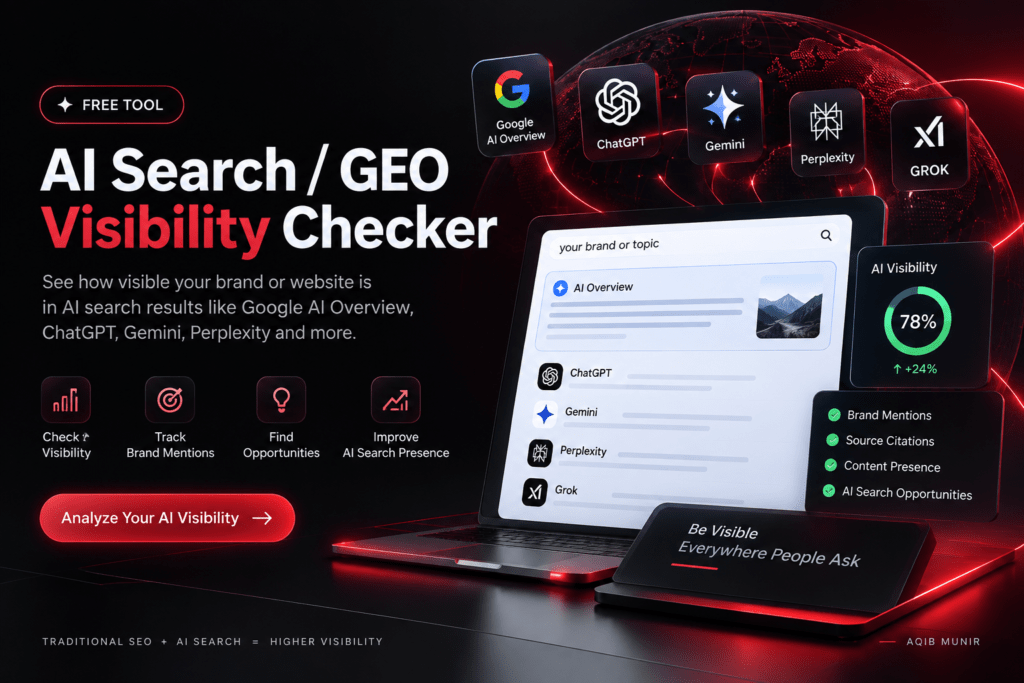
AI Search / GEO Visibility Checker.
Analyze whether a page is prepared for AI-powered search experiences with a practical GEO and AEO readiness review covering content, entities, questions, structure and search intent.
Check Your GEO & AEO Readiness.
Enter a page URL, target search question and optional page content. The tool evaluates the information you provide and produces a practical readiness score with improvement suggestions.
Analyze Your Page
For the most useful browser-only analysis, paste the main visible page text along with the URL and target query.
Visibility Results
Your GEO/AEO readiness assessment will appear here.
Signals That Matter for AI Search Readiness.
AI search visibility is not determined by one simple ranking factor. This tool provides a practical content and structure review rather than a prediction of whether an AI system will cite a page.
Search Intent
Reviews whether the supplied content addresses the user's target question directly and clearly.
Answer Readiness
Looks for concise answers, useful explanations and question-focused content that can be understood easily.
Entity Signals
Checks for identifiable brand, business, person or topic entities within the supplied content.
Semantic Coverage
Reviews topical breadth and related terminology around the target question.
Content Structure
Looks for headings, readable sections, FAQs and structured information that support comprehension.
Trust Signals
Identifies basic author, business, evidence and credibility signals where they are present in the supplied content.
How to Improve AI Search Readiness.
Use the results as a practical checklist. Strong AI-search optimization starts with useful content, clear entities, accurate information and pages that satisfy the underlying search intent.
Start important sections with direct answers, then add supporting detail, examples and context.
Make it clear who you are, what the business does, what products or services are offered and how the entities relate.
Cover important subtopics and related questions instead of relying on one isolated keyword or page.
Use accurate facts, first-hand information, references, authorship and other appropriate trust signals where relevant.
Implement relevant structured data that accurately represents the visible page content and its entities.
Optimize for people first. Avoid writing artificial passages simply to insert keywords or AI-search terminology.
AI Search Optimization Checklist.
Understand what the user is actually trying to accomplish before optimizing content for a query.
Write clear, helpful content that answers real questions instead of forcing repetitive keyword variations.
Connect your brand, people, services, products, locations and topics with accurate contextual information.
Address meaningful related questions and follow-up needs where they genuinely help the reader.
Use descriptive headings, internal links, clean navigation and structured content to make relationships easier to understand.
AI search systems can change and may not expose complete citation or visibility data, so combine multiple measurement methods.
AI Search & GEO FAQs.
It provides a practical readiness assessment using the URL, target question and page content you enter. It reviews intent alignment, answer readiness, entity signals, semantic coverage, structure and basic trust signals.
No. This version runs in the browser and does not query ChatGPT, Gemini, Google AI Overviews or another AI engine for live citation data.
GEO commonly refers to Generative Engine Optimization: optimizing content and digital signals so information is easier for generative search and answer systems to understand and use.
AEO commonly refers to Answer Engine Optimization: structuring and improving content so it directly addresses questions and can be clearly understood by answer-focused search experiences.
No. The score is a practical diagnostic created by this tool. It is not an official Google, ChatGPT, Gemini or other AI-search ranking metric.
A browser-only widget cannot reliably fetch and inspect every external website because of security and CORS restrictions. Supplying the page content lets the tool perform its analysis directly in your browser.
Yes. Clear intent, useful answers, strong topical coverage, entity clarity, accurate information, good site structure and appropriate trust signals are more useful than repetitive keyword insertion.
Ready to Improve Your AI Search Visibility?
Use the analysis as a starting point for a stronger GEO, AEO and AI-search content strategy.
LET'S TALK ABOUT AI SEARCH →