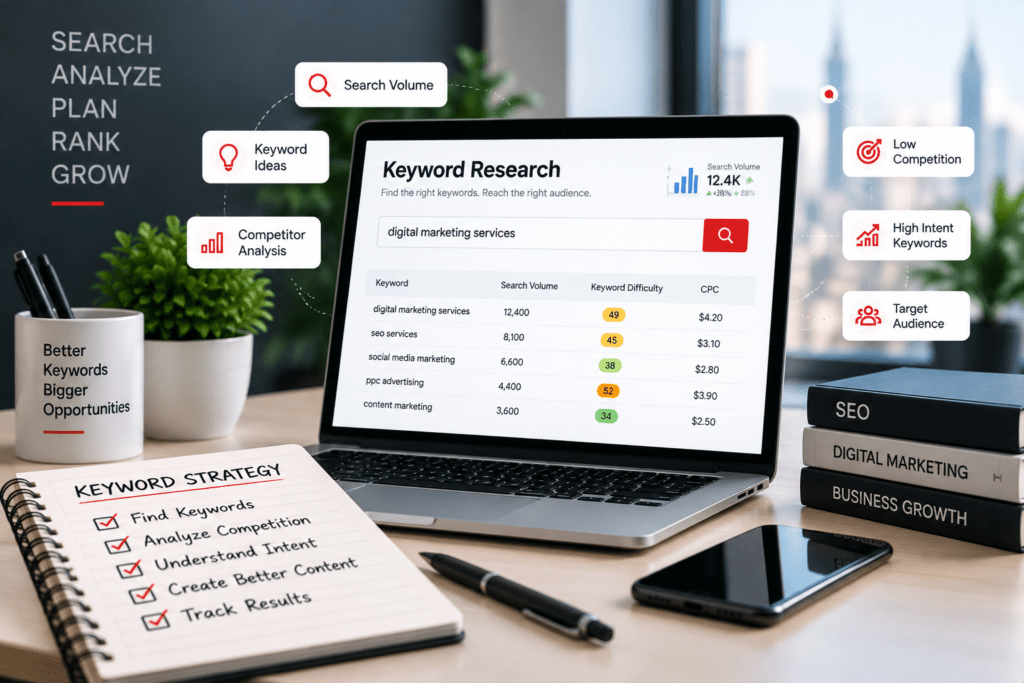

KEYWORD RESEARCH
Find The Right Keywords For Your SEO Strategy.
I turn search data, search intent and competitor insights into a focused keyword strategy designed to help your website target the searches that matter.

Research Focus
Intent • Demand • Competition
01
The Foundation Of Effective SEO
Good keyword research is not about collecting thousands of keywords. It is about identifying the searches that have relevance, intent and potential value for your business.
WHY KEYWORD RESEARCH MATTERS
Search Data Should Lead To Better Decisions.
I analyse what people search for, how they search, what appears in the SERPs and how competitive each opportunity is. This creates a clearer direction for your website, content and overall SEO strategy.
WHAT I ANALYZE
More Than Search Volume. Real Opportunities.
Each keyword is evaluated from a business, search and competitive perspective.
01 / DATA
Search Volume
Understand the level of demand behind important search terms and topics.
02 / COMPETITION
Keyword Difficulty
Evaluate competition and identify opportunities that are realistic to pursue.
03 / INTENT
Search Intent
Understand whether users are researching, comparing, buying or looking for a solution.
04 / SERP
SERP Analysis
Study the current search results and the type of content Google is showing.
05 / COMPETITORS
Competitor Keywords
Discover relevant opportunities and content gaps across competing websites.
06 / BUSINESS
Commercial Value
Prioritize keywords based on their relevance to your products, services and goals.
MY PROCESS
From Research To A Clear SEO Roadmap.
A structured process turns search data into practical SEO priorities.
01
Understand The Business
Analyse your services, products, audience, market and business objectives.
02
Build The Keyword Universe
Collect relevant keyword variations, questions, topics and long-tail opportunities.
03
Analyse Search Data
Evaluate search demand, competition, trends and keyword difficulty.
04
Map Search Intent
Group keywords according to what users actually expect to find.
05
Analyse Competitors
Identify ranking opportunities, competitor keywords and content gaps.
06
Build The Strategy
Map keywords to pages, topics and content priorities.
FROM KEYWORD TO STRATEGY
A Keyword Is Only The Starting Point.
The real value comes from connecting search intent with your website structure and content.
Keyword
Search Intent
Topic Cluster
Target Page
Content
SEO Optimization
DIFFERENT BUSINESS NEEDS
Keyword Research For Different Websites.
The right keyword strategy depends on your business model, audience and search behaviour.
Local SEO
Location-based searches and local customer intent.
E-commerce
Product, category and commercial search opportunities.
Service Businesses
High-value service and solution-focused searches.
B2B Websites
Industry-specific and decision-stage search terms.
Content Websites
Informational topics, questions and content opportunities.
New Websites
Prioritized opportunities for building organic visibility.
SEO TOOLKIT
Research Backed By Reliable Data.
I combine multiple data sources to understand search demand, competition and opportunities.
Ahrefs
Semrush
Google Keyword Planner
Google Search Console
Google Trends
Screaming Frog
WHAT YOU GET
Research That Becomes An SEO Plan.
The research is organized into practical insights that can support your SEO and content strategy.
✓
Target Keyword Opportunities
✓
Search Intent Classification
✓
Keyword Difficulty Analysis
✓
Competitor Keyword Insights
✓
Keyword Mapping
✓
Content Opportunities
✓
Topic Cluster Recommendations
✓
SEO Priority Roadmap
LET'S TALK SEO
Know What Your Customers Are Searching For?
Let's turn search demand into a focused keyword strategy built around your website, audience and business goals.
Let's Talk About Your SEO Strategy →