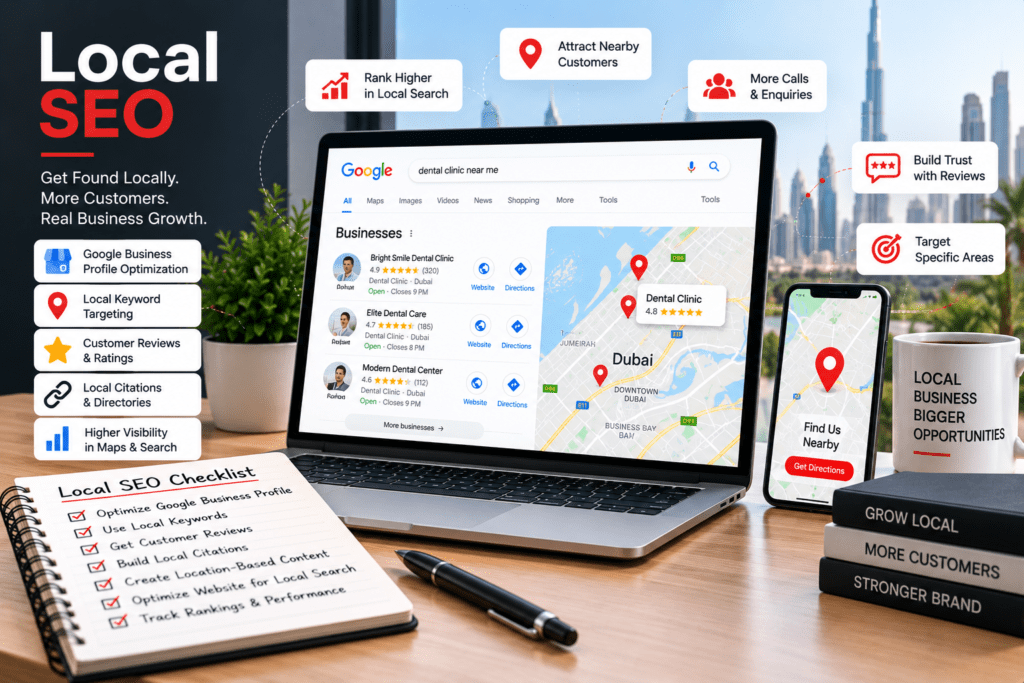
LOCAL SEO
GOOGLE BUSINESS PROFILE
LOCAL SEARCH VISIBILITY
LOCAL KEYWORD RESEARCH
GOOGLE MAPS SEO
LOCAL CITATIONS
LOCAL RANKINGS
LOCAL SEO
GOOGLE BUSINESS PROFILE
LOCAL SEARCH VISIBILITY
LOCAL KEYWORD RESEARCH
GOOGLE MAPS SEO
LOCAL CITATIONS
LOCAL RANKINGS
LOCAL SEO
Get Found in Your
Local Area.
I help businesses improve their local search visibility, strengthen their Google Business Profile presence, reach nearby customers and build a stronger local digital presence.
LOCAL
SEO
VISIBILITY
GOOGLE MAPS
LOCAL RANKINGS
NEARBY CUSTOMERS
LOCAL SEARCH
Local SEO Helps Customers
Find Your Business.
Local SEO connects your business with people searching for products and services in your area. I focus on improving the signals that help search engines understand your business, location, services and relevance to local customers.
Local Visibility
Improve your presence across local search results.
Local Relevance
Connect your business with relevant local searches.
Customer Discovery
Help nearby customers discover your business.
LOCAL SEO SERVICES
Building a Stronger
Local Search Presence.
Local SEO involves more than adding a location to your website. I work across the key areas that influence local visibility, relevance and customer discovery.
01
Google Business Profile
Optimize your Google Business Profile information, categories, services and overall local presence.
02
Local Keyword Research
Identify relevant location-based keywords and search opportunities aligned with your services.
03
Google Maps SEO
Improve the local search signals that support visibility across Google Maps and local results.
04
Local Citations
Review business listings and citation consistency across relevant local directories and platforms.
05
Local On-Page SEO
Optimize location pages, service pages, titles, content and other website signals for local search.
06
Local Link Building
Identify relevant local authority and link opportunities that can support stronger local relevance.
07
Review Strategy
Develop practical approaches for encouraging and managing authentic customer reviews.
08
Local Competitor Analysis
Analyze competing businesses, local search presence, keywords and opportunities.
09
Local SEO Optimization
Continuously review local performance and identify areas for further optimization.
LOCAL SEO STRATEGY
Local Search Works When
Every Signal Connects.
A strong local strategy brings together your business, location, services, website, Google Business Profile and local authority.
01 / RELEVANCE
Be Relevant
Align your business information and content with the searches your local customers actually make.
02 / LOCATION
Be Local
Strengthen location signals across your website, business profile and local listings.
03 / AUTHORITY
Build Trust
Develop consistent business information, citations, reviews and relevant authority signals.
04 / VISIBILITY
Improve Discovery
Make it easier for customers to discover your business when searching locally.
MY LOCAL SEO PROCESS
From Local Audit to
Better Visibility.
I use a structured approach to identify local search opportunities, improve important signals and measure progress.
01
Audit the Local Presence
Review the website, Google Business Profile, listings, local signals and existing visibility.
02
Research Local Searches
Identify relevant local keywords, services, locations and search intent.
03
Analyze Competitors
Review competing businesses and identify gaps and opportunities in local search.
04
Optimize Local Signals
Improve relevant website, profile, citation and business information signals.
05
Build Local Authority
Strengthen relevant citations, reviews, local mentions and authority opportunities.
06
Measure & Optimize
Monitor local search performance and continue improving the strategy based on available data.
LOCAL CUSTOMER JOURNEY
From Local Search to
Customer Discovery.
Local SEO connects search intent with your business presence and the customer journey.
Local Search
→
Google Maps
→
Business Profile
→
Website
→
Enquiry
→
Customer
WHO I HELP
Local SEO for Different
Business Needs.
Local search strategies can be adapted to different types of businesses and customer journeys.
Local Service Businesses
Improve visibility for customers searching for services in specific areas.
Medical & Healthcare
Build a stronger local presence for clinics, centers, pharmacies and healthcare services.
Restaurants & Cafes
Support local discovery when customers are searching for nearby dining options.
Retail Businesses
Strengthen local visibility for businesses serving customers from physical locations.
Professional Services
Improve local search presence for consultants, agencies, financial and professional service providers.
Multi-Location Businesses
Develop structured local SEO foundations for businesses operating across multiple locations.
LOCAL SEO DELIVERABLES
A Structured Local SEO
Optimization Plan.
Depending on the business and objectives, local SEO work can cover the following areas.
✓
Google Business Profile Optimization
✓
Local Keyword Research
✓
Google Maps SEO
✓
Local Search Analysis
✓
Local Competitor Research
✓
Local On-Page SEO
✓
Location Page Optimization
✓
Local Citation Analysis
✓
Business Listing Consistency
✓
Review Strategy
✓
Local Link Building Opportunities
✓
Local Content Strategy
✓
NAP & Business Information Review
✓
Local Schema Review
✓
Local SEO Performance Analysis
✓
Ongoing Local SEO Optimization
LOCAL SEO
Ready to Improve Your
Local Search Visibility?
Let's build a stronger local search presence and make it easier for the right customers to discover your business.
LET'S TALK ABOUT LOCAL SEO ↗FAQS
What is Local SEO and how does it differ from traditional SEO?
Local SEO is the specialized practice of optimizing your online presence to attract customers from a specific geographic area. While traditional SEO focuses on national or global search rankings regardless of location, Local SEO targets geographic search queries (e.g., “plumber near me” or “best restaurant in Dubai”) by prioritizing Google Map Pack visibility, localized business citations, and geo-targeted keywords.
Core Differences:
Target Audience: Local SEO captures nearby buyers with high purchase intent, while traditional SEO targets broad informational search queries.
Primary Ranking Platforms: Local SEO relies heavily on Google Business Profile, Google Maps, and Bing Places; traditional SEO targets standard organic website rankings.
Core Ranking Signals: Physical proximity to the searcher, NAP (Name, Address, Phone) consistency, and local reviews drive Local SEO.
How do you rank in the Google Local 3-Pack (Map Pack)?
To rank in the Google Local 3-Pack, businesses must fully optimize their Google Business Profile (GBP), build localized entity signals, maintain accurate Name, Address, and Phone (NAP) data across directories, and collect continuous 5-star customer reviews.
High-Impact Local Map Pack Checklist:
Complete Business Details: Fill out all business categories, working hours, services, and high-resolution photo assets.
Build Local Citations: Standardize NAP information across authoritative platforms (YellowPages, local directories, chambers of commerce).
Drive Customer Reviews: Set up automated review requests via email/WhatsApp to consistently generate genuine feedback.
Embed Local Maps: Add Google Maps embeds and localized structured schema (
LocalBusiness) to main contact pages.
How do reviews and ratings impact local search engine rankings?
Online customer reviews directly influence local search rankings and user conversion rates. Search engines like Google treat review volume, star ratings, review velocity, and response times as critical trust metrics to determine map rankings and AI Overview placements.
| Review Signal | Ranking & User Conversion Impact | Optimization Best Practice |
| Star Rating Average | Listings below 4.0 stars suffer a massive drop in organic clicks. | Maintain high service standards to secure 4.5+ star ratings. |
| Review Keywords | Unprompted customer references to specific services improve keyword relevance. | Encourage customers to mention specific services in feedback. |
| Owner Response Rate | Responding quickly signals active, trustworthy business management. | Reply to positive and negative reviews within 24–48 hours. |
How can small businesses optimize Local SEO for Google AI Overviews and Voice Search?
Optimizing Local SEO for Google AI Overviews and Voice Search requires focusing on conversational natural-language long-tail keywords, clear entity references, and structured schema markup. AI platforms pull direct facts from Google Business Profiles, web content, and customer reviews to deliver precise answers.
Optimization Strategy for AI Local Search:
Answer Local Questions: Include direct 40–50 word summaries addressing local FAQs beneath main headings.
Optimize for “Near Me” Queries: Incorporate neighborhood names, landmarks, and city qualifiers across landing page content.
Implement Schema Markup: Use JSON-LD
LocalBusinessandGeoCoordinatesschema to explicitly define your business location to AI web crawlers.
Why is local citation consistency crucial for multi-location SEO?
Local citation consistency means keeping your business Name, Address, and Phone number (NAP) identical across every online directory and mapping service. Conflicting business details dilute search engine trust, leading to drops in local rankings and lost customer calls.
Expert Implementation Strategy:
As Aqib Munir (Digital Marketing & SEO Expert) emphasizes, resolving mismatched directory profiles and duplicate GBP listings is the foundational first step to unlocking map pack rankings for multi-location brands.
Conduct semi-annual directory audits using listing management platforms to eliminate incorrect phone numbers or outdated addresses.