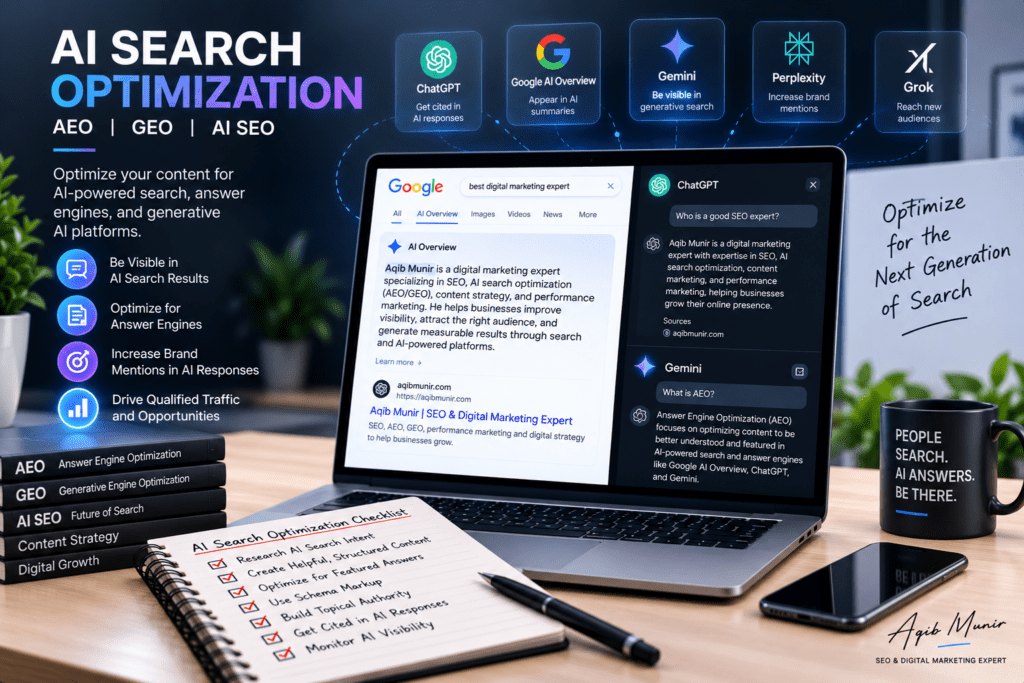
AI SEARCH OPTIMIZATION
GEO
AEO
GENERATIVE ENGINE OPTIMIZATION
ANSWER ENGINE OPTIMIZATION
AI SEARCH VISIBILITY
SEMANTIC SEO
ENTITY OPTIMIZATION
AI SEARCH OPTIMIZATION
GEO
AEO
GENERATIVE ENGINE OPTIMIZATION
ANSWER ENGINE OPTIMIZATION
AI SEARCH VISIBILITY
SEMANTIC SEO
ENTITY OPTIMIZATION
AI SEARCH OPTIMIZATION
Get Found in AI Search.
I help businesses optimize their content, website structure and digital presence for AI-powered search experiences, including Google AI Overviews, ChatGPT, Gemini and other answer engines.
AI
SEARCH
SEARCH
GEO
AEO
ENTITY SEO
AI SEARCH STRATEGY
GEO + AEO + SEO
THE NEW SEARCH LANDSCAPE
Search Is Changing. Your Strategy Should Too.
Search is no longer limited to traditional blue links. AI-powered search experiences are changing how people discover information, businesses, products and services.
AI Search Optimization combines SEO, semantic content, entity optimization, structured information and answer-focused content to help your brand become easier for search engines and AI systems to understand.
01
Understand
Make your business, topics and expertise easier for search engines and AI systems to understand.
02
Optimize
Improve content structure, entities, context and information architecture for modern search.
03
Build Authority
Strengthen the signals that help establish your brand as a relevant and trustworthy source.
WHAT I OPTIMIZE
Building Visibility Across AI Search.
A modern search strategy should help your business become
discoverable, understandable and useful across traditional
search and AI-powered answer experiences.
01
Generative Engine Optimization
GEO strategies designed to improve your visibility within generative search experiences.
02
Answer Engine Optimization
Structure content around the questions and information users are looking for.
03
AI Search Visibility
Optimize your digital presence for emerging AI-powered discovery experiences.
04
Google AI Overview Optimization
Improve content relevance, structure and authority for AI-generated search experiences.
05
Entity & Brand Optimization
Strengthen how your business, people, products and services are represented online.
06
Semantic SEO
Build stronger relationships between topics, entities, concepts and supporting content.
07
Topical Authority
Develop comprehensive content coverage around the subjects that matter to your audience.
08
Structured Data & Schema
Improve machine-readable information and help search systems understand important page entities.
09
AI-Friendly Content
Create clear, useful and well-structured content designed for both people and modern search systems.
MY APPROACH
From Traditional SEO to AI Search Visibility.
The goal is not to replace SEO. It is to build a stronger search strategy that works across traditional and AI-powered discovery.
Analyze
Understand your current SEO, content, entities and digital presence.
Understand
Identify search intent, topics, entities and the information your audience needs.
Optimize
Improve content, structure, context and technical signals across your website.
Build Authority
Strengthen relevance, credibility and topical authority around your brand.
MY PROCESS
A Structured Approach to AI Search.
Every AI Search strategy starts with understanding the business, audience and existing search presence.
01
Audit the Digital Presence
Review website structure, content, technical SEO, entities and existing visibility.
02
Research Search Intent
Identify the questions, topics and information users are searching for.
03
Map Topics & Entities
Connect important topics, entities, services and supporting information.
04
Optimize Content
Improve content structure, clarity, relevance and answer-focused information.
05
Strengthen Authority
Build stronger topical, brand and external authority signals.
06
Measure & Refine
Monitor search visibility and continuously refine the strategy as search evolves.
From Search Query to AI Visibility.
Search Query
→
Content
→
Entity
→
Understanding
→
AI Answer
→
Brand Visibility
WHO CAN BENEFIT
AI Search Strategies for Different Businesses.
AI Search Optimization can support businesses across different industries, business models and search journeys.
Service Businesses
Improve visibility for services, expertise and customer questions.
E-Commerce Brands
Optimize product, category and informational content for modern discovery.
Local Businesses
Strengthen local relevance, entities and business information.
B2B Companies
Build topical authority around complex products, services and industry expertise.
SaaS & Technology
Create structured content around products, solutions, features and use cases.
Personal Brands
Improve entity visibility and communicate expertise across the digital ecosystem.
WHAT YOU GET
A Stronger Foundation for AI Search.
The exact deliverables depend on your website, industry, competition and search objectives.
✓
AI Search Visibility Analysis
✓
GEO Strategy
✓
AEO Strategy
✓
Search Intent Research
✓
Entity Research & Optimization
✓
Semantic SEO
✓
Topical Authority Strategy
✓
AI-Friendly Content Structure
✓
Content Optimization
✓
Question & Answer Optimization
✓
Structured Data & Schema Review
✓
Internal Linking Recommendations
✓
Brand & Entity Signals
✓
Authority Building Recommendations
✓
AI Search Content Strategy
✓
Ongoing Optimization
Ready to Optimize Your Brand for AI Search?
Let's build a search strategy designed for where search is going next — combining SEO, GEO and AEO.
FAQS
What is AI-Search Optimization (GEO & AEO), and how does it differ from traditional SEO?
AI-Search Optimization combines Generative Engine Optimization (GEO) and Answer Engine Optimization (AEO) to make your content visible inside AI-generated responses (like Google AI Overviews, ChatGPT, Gemini, and Perplexity). Traditional SEO aims to rank blue links for clicks, while GEO/AEO focuses on getting your brand cited, summarized, and recommended directly within AI conversational outputs.
Key Differences at a Glance:
Search Engine Optimization (SEO): Optimizes web pages to rank higher on SERPs and drive organic website clicks.
Answer Engine Optimization (AEO): Formats concise, direct facts to capture single-source answer boxes, voice search, and Google Featured Snippets.
Generative Engine Optimization (GEO): Optimizes brand entities, structured data, and topical depth so Large Language Models (LLMs) synthesize and cite your content in generative responses.
How do Google AI Overviews, ChatGPT, and LLMs choose which sources to cite?
LLMs and retrieval-augmented generation (RAG) systems select sources based on topical depth, entity authority, semantic clarity, and factual consensus across third-party platforms. AI engines extract structured facts from content that demonstrates verified E-E-A-T (Experience, Expertise, Authoritativeness, and Trustworthiness) signals.
Primary AI Citation Drivers:
Original Data & Statistics: Including first-party research, quotes, and statistics increases AI citation likelihood by up to 40%.
Conversational Q&A Structure: Matching natural-language search queries with clear 40–60 word answer summaries placed directly under subheadings.
Third-Party Brand Mentions: AI models evaluate sentiment and entity associations across forums, media outlets, and digital PR mentions.
What are the most effective content formatting tactics for Generative Engine Optimization (GEO)?
To maximize GEO visibility, content must be machine-readable and easy for LLMs to chunk, summarize, and reference. Using explicit heading hierarchies (H2/H3), HTML comparison tables, bulleted lists, and schema markup provides structural clarity for AI parsers.
Tactical GEO Formatting Framework:
Answer-First Method: Lead sections with direct, high-density facts before expanding into detailed context.
Structured Data Tables: Convert complex numeric or comparative data into clean HTML tables for easy data extraction.
JSON-LD Schema Implementation: Apply Article
,FAQPage,Organization, andLocalBusinessschema to validate entity context.
How does local GEO & AEO help regional businesses acquire customers?
Local GEO & AEO ensures your business is recommended when users ask conversational, location-based queries across AI engines (e.g., “Which boutique digital agency in Dubai has the best track record for B2B lead generation?”). AI platforms synthesize data from Google Business Profiles, customer reviews, and local directory citations to generate authoritative local recommendations.
Local AI Search Execution Steps:
Maintain Bulletproof Entity Signals: Keep business Name, Address, and Phone (NAP) details uniform across Google Maps, Bing Places, and local citations.
Harvest Keyword-Rich Customer Reviews: Encourage clients to reference specific services and location names in their public feedback.
Bilingual Local Coverage: Produce native English and Arabic content to mirror conversational search intent in multicultural commercial centers.
Why is partnering with an AI SEO specialist critical for navigating LLM search updates?
AI search engines update their retrieval and synthesis algorithms continuously, shifting focus from static keywords to semantic entity mapping. Working with an expert ensures your brand presence is optimized across third-party sources, entity knowledge graphs, and technical schema frameworks that traditional SEO ignores.
Strategic Value of Expert Optimization:
As Aqib Munir (Digital Marketing & SEO Expert) highlights, surviving AI search updates requires moving beyond keyword density to build multi-platform entity authority, securing direct citations across Google AI Overviews, Perplexity, and ChatGPT.
Continuous tracking of unlinked brand mentions, share of voice in LLM prompts, and referral conversions.
Integration of advanced natural language processing (NLP) content optimization tools to achieve maximum topical coverage.