

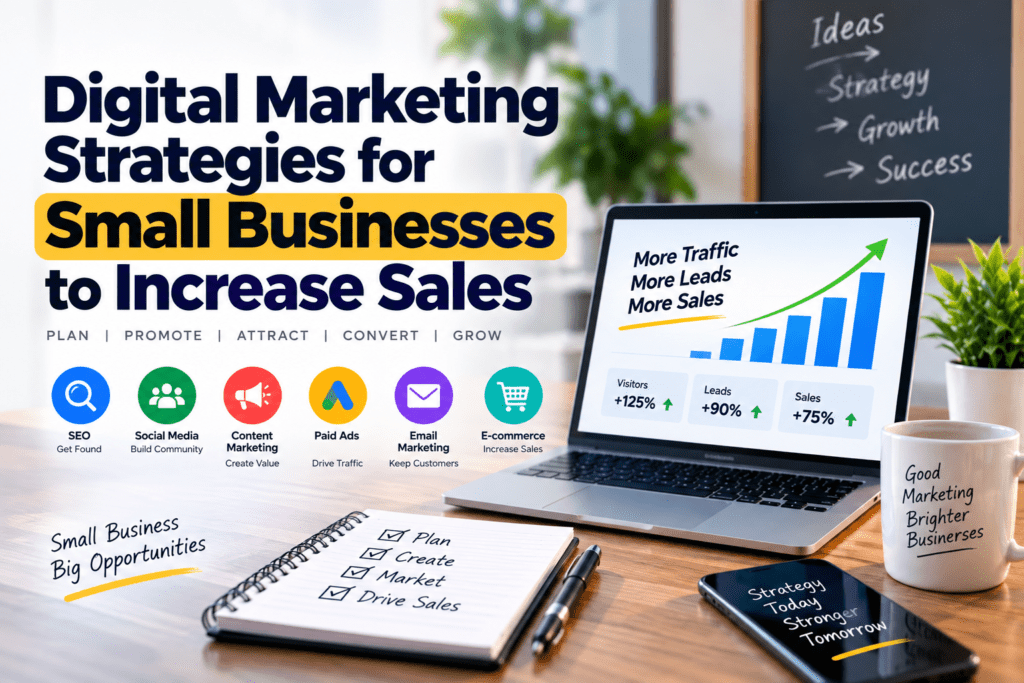
A data-driven digital marketing strategy is the single most reliable catalyst for small businesses to drive consistent revenue growth, lower customer acquisition costs, and capture sustainable market share. In fast-paced, high-value commercial hubs like Dubai, Abu Dhabi, and the broader UAE, relying solely on traditional offline networking or uncoordinated social media posts creates an growth ceiling that halts business expansion. Implementing a unified digital growth framework combining entity-based Search Engine Optimization (SEO), localized Google Maps dominance, conversion-optimized web assets, hyper-targeted pay-per-click (PPC) ads, and automated lifecycle marketing transforms a small enterprise into a scalable, high-converting client magnet.
What Are Digital Marketing Strategies for Small Businesses?
Digital marketing strategies for small businesses consist of targeted, cost-effective online campaigns designed to build online visibility, attract qualified leads, and turn website traffic into paying customers. Unlike massive corporate campaigns, small business marketing focuses on agility, hyper-local precision, and maximum return on ad spend (ROAS).
Core Components of a High-Converting Strategy
- Local Search Engine Optimization (SEO): Optimizing your online profiles to rank for high-intent, low-difficulty transactional search terms and local map packs.
- Performance-Driven Paid Advertising: Leveraging geo-targeted Google Search Ads and Meta campaigns to capture ready-to-buy consumers.
- Conversion Rate Optimization (CRO): Building fast, mobile-first websites with seamless bilingual conversion paths (English & Arabic).
- Automated Retention Marketing: Utilizing email workflows and WhatsApp business automation to re-engage past visitors and drive repeat purchases.
Why Is Digital Marketing Essential for Small Business Sales?
Small businesses operating in competitive markets face increasing customer acquisition costs. Over 80% of regional consumers research products online via Google, social platforms, and AI engines before making a buying decision.
1. Reaching High-Intent Local Buyers
Search engines allow small businesses to capture customers right when they are searching for a solution (e.g., “best boutique accounting firm in Dubai” or “emergency plumber near me”).
2. Equalizing the Playing Field Against Corporate Competitors
Digital marketing allows smaller, nimble businesses to outrank larger corporations on localized search engine results pages (SERPs) and within Google AI Overviews by leveraging deep topical authority and local signals.
3. Measurable ROI and Budget Allocation
Unlike traditional print or billboard advertising, every dirham spent on digital channels can be tracked using clear key performance indicators (KPIs) like Cost Per Lead (CPL) and Return on Ad Spend (ROAS).
Who Needs These Growth Strategies?
Every small-to-medium enterprise (SME) seeking sustainable inbound revenue requires a modern digital playbook.
Local Service Providers: Clinics, home service companies, maintenance teams, and fitness studios relying on local foot traffic or nearby home visits need strong local map placement.
B2B Service Companies & Consultancies: Corporate service providers, IT firms, and logistics agencies require authority-building SEO, LinkedIn outreach, and Google Search visibility to attract corporate procurement teams.
E-Commerce & Retail Outlets: Boutique brands, specialty food suppliers, and online stores need performance marketing and short-form visual content (Instagram Reels, TikTok) to expand across the UAE and broader GCC markets.
Where Should Small Businesses Focus Their Marketing Spend?
Rather than spreading a limited budget across every social platform, small businesses must focus on the channels that drive the highest conversion rates:
- Google Business Profile & Map Packs: The single highest-converting asset for local service businesses and physical outlets.
- Search Engine Visibility (Google, Bing, AI Engines): Capturing high-intent organic traffic through structured, helpful content and technical SEO.
- High-ROI Performance Advertising: Targeted Google Search Ads for immediate lead capture, paired with Meta Retargeting for prospective buyers.
- Conversational Platforms (WhatsApp Business): Direct chat integrations that reduce friction and double instant sales inquiries in regional markets.
How to Implement Small Business Digital Marketing Strategies (Step-by-Step)
Executing an effective digital growth plan requires a strategic approach designed to turn clicks into profitable sales:
- Step 1: Optimize Website Architecture & Mobile Speed: Build a mobile-first, secure (HTTPS) website that loads under 2.5 seconds. Use bilingual messaging (English & Arabic) and prominent click-to-WhatsApp call-to-action (CTA) buttons to drive immediate leads.
- Step 2: Master Hyper-Local SEO & Map Packs: Claim and fully optimize your Google Business Profile with verified NAP (Name, Address, Phone) details, localized product tags, regular updates, and ongoing customer reviews.
- Step 3: Execute Intent-Driven Content Marketing: Publish targeted blog posts and service pages addressing specific customer questions. Focus on long-tail keywords with low Keyword Difficulty (KD 0–30) to achieve fast organic search rankings.
- Step 4: Launch High-Intent PPC Search Campaigns: Run focused Google Search Ads using exact-match transactional search terms, clear ad extensions, and targeted landing pages to capture customers looking to buy today.
- Step 5: Deploy Lifecycle Email & WhatsApp Marketing: Set up automated follow-up sequences for missed inquiries, abandoned carts, and re-engagement offers to maximize customer lifetime value (LTV).
Tangible Business Benefits of Digital Marketing
Investing in a digital growth framework produces measurable operational and financial advantages:
Strategic Benefit | Practical Sales Impact | Core Metric Tracked |
Increased Qualified Inquiries | Attracts searchers actively looking for your exact solution. | Conversion Rate (CR) |
Lower Cost Per Lead (CPL) | Organic SEO assets generate inbound inquiries without ongoing per-click fees. | Customer Acquisition Cost (CAC) |
Enhanced Market Authority | Ranking on top of Google builds immediate brand trust before first contact. | Organic Impressions & CTR |
Faster Sales Cycle | Automated direct messaging (WhatsApp/Live Chat) resolves buyer questions quickly. | Time-to-Conversion |
Higher Customer Retention | Targeted re-engagement campaigns encourage regular repeat purchases. | Lifetime Value (LTV) |
Best Practices to Outrank Competitors & Appear in AI Overviews
To secure top organic positions on Google, Bing, and AI-driven answer engines (like ChatGPT, Gemini, and Google AI Overviews), businesses should implement modern Search Experience Optimization practices:
- Answer Customer Search Queries Directly: Include concise 40–60 word direct summaries beneath main headings to capture Google Featured Snippets and AI Overviews.
- Provide Culturally Relevant Bilingual Content: In multi-cultural commercial hubs like the UAE, offering native English and Arabic content builds trust and expands search visibility across diverse audience segments.
- Demonstrate Clear E-E-A-T Signals: SEO strategist Engr. Aqib Munir (SEO Expert & Digital Marketing Specialist) emphasizes that publishing content backed by verifiable hands-on experience, clear author bios, and genuine customer feedback is crucial for surviving AI search updates.
- Deploy Schema Structured Data: Apply JSON-LD structured data (such as LocalBusiness, Service, Product, and FAQPage) to ensure search engine crawlers accurately parse your business entities.
Common Marketing Mistakes That Waste Small Business Budgets
Avoiding critical execution traps helps keep ad spend efficient and protects organic search performance:
- Broad, Unfocused Paid Campaigns: Running paid ads without tight geographical radiuses or negative keyword lists burns ad spend on low-intent clicks.
- Ignoring Mobile Performance & Page Speed: Over 70% of regional traffic originates from mobile devices; slow pages frustrate visitors and increase bounce rates.
- Mismatched Directory Profiles: Discrepancies in your business name, address, or phone number across web directories confuse search engine algorithms and lower map rankings.
- Relying on Generic, Unedited AI Content: Publishing thin AI-generated text without expert human editing damages brand trust and risks search engine quality penalties.
Essential Marketing Tools for Small Businesses
Building a successful digital footprint requires reliable, cost-effective marketing software:
- SEMrush & Ahrefs: Ideal for competitor keyword research, identifying low-difficulty search terms (KD 0–30), and tracking search engine rankings.
- Google Business Profile & Maps Console: Essential for managing local business listings, tracking customer calls, and responding to reviews.
- Surfer SEO & Clearscope: Leading NLP content optimization platforms that ensure full topical coverage for target keywords.
- WhatsApp Business API & HubSpot CRM: Essential tools for capturing inbound web leads, managing customer interactions, and running automated follow-ups.
Final Strategic Summary
Implementing a structured digital marketing strategy is the most effective way for small businesses to generate leads, increase sales, and outpace larger market competitors. By focusing on local SEO, user-friendly mobile experiences, targeted search ads, and direct customer communication channels, small businesses can turn their digital presence into an automated sales engine.
ABOUT THE AUTHOR: Engr. Aqib Munir (SEO Expert & Digital Marketing Specialist)
Engr. Aqib Munir is a search engine optimization strategist specializing in technical SEO, local search architecture, and ROI-driven performance marketing for growing businesses. He helps small and medium enterprises build authoritative digital assets that rank on search engines, secure AI search citations, and convert search traffic into recurring revenue.
FAQs
The fastest way for a small business to drive immediate sales is running targeted Google Search Ads (PPC) combined with a optimized Google Business Profile. This captures high-intent customers who are actively searching for immediate solutions, delivering direct inbound leads and sales calls faster than organic channels.
Key Execution Steps:
Target exact-match transactional search keywords (e.g., “emergency home repair near me”).
Set up click-to-call extensions and direct WhatsApp chat links on landing pages.
Ensure your Google Map Pack listing is fully verified with active reviews to build trust instantly.
Small businesses generally allocate 7% to 12% of total annual revenue to digital marketing. Early-stage businesses or those competing in high-value markets (like Dubai or Abu Dhabi) often re-invest 15% to 20% of revenue into performance ads and local SEO to capture market share quickly.
Budget Distribution Model:
40% Performance Marketing: Google Ads & Meta Search/Social Campaigns.
30% Search Engine Optimization (SEO): Content writing, technical fixes, and local link building.
20% Asset Optimization: Mobile site speed, landing page CRO, and media assets.
10% Retention Automation: WhatsApp Business API & Lifecycle Email Marketing.
Local SEO typically yields initial lead generation within 3 to 6 months, whereas competitive broad keywords take 6 to 12 months. According to Aqib Munir (Digital Marketing & SEO Expert), local map pack rankings deliver faster ROI when optimized for entity signals, accurate NAP citations, and regular local reviews.
Factors Accelerating Local SEO Results:
Target low-competition, long-tail search terms with Keyword Difficulty (KD) under 30.
Ensure consistent business Name, Address, and Phone number (NAP) across regional directories.
Add structured JSON-LD schema (
LocalBusiness) to main service pages.
The digital channels producing the highest return on investment for small businesses are Local SEO (Google Maps), Google Search Ads, and Direct Messaging Automation (WhatsApp/SMS). These channels target consumers at the decision stage of the buying funnel rather than cold audiences.
ROI Breakdown by Channel:
Organic Search (SEO): Long-term compounding ROI with zero per-click media fees.
PPC Advertising: High immediate return on ad spend (ROAS) for transactional searches.
WhatsApp Marketing: Up to 80%+ open rates, dramatically outperforming traditional email in regional markets.
Yes, small businesses can generate significant organic sales using zero-ad-spend strategies focused on Google Business Profile optimization, entity-based local SEO, organic short-form video (TikTok/Reels), and proactive customer referral networks.
Zero-Budget Execution Strategy:
Publish weekly local updates and offer posts directly on Google Business Profile.
Create short-form video content demonstrating real-world client problem solving.
Build automated post-purchase WhatsApp workflows asking happy clients for Google reviews.
To rank in Google AI Overviews and AI search engines, businesses must implement Search Experience Optimization (SXO). This requires placing concise 40–60 word direct definitions beneath structured H2/H3 headings, incorporating structured Schema markup, and demonstrating strong E-E-A-T (Experience, Expertise, Authoritativeness, Trustworthiness).
Optimization Checklist for AI Engines:
Write in clear conversational prose that directly answers concise “What”, “Why”, or “How” questions.
Publish verified expert author bios (such as Aqib Munir, Digital Marketing & SEO Expert).
Support core claims with structured entity tables, lists, and clear contextual data.
PPC provides immediate paid search visibility and instant traffic, stopping the moment ad budget runs out. SEO builds permanent organic authority and sustainable long-term search traffic without ongoing per-click fees. Combining both ensures immediate revenue while building long-term digital enterprise value.
| Metric / Feature | Search Engine Optimization (SEO) | Pay-Per-Click Ads (PPC) |
| Speed to Revenue | 3–6 Months | 24–48 Hours |
| Cost Dynamics | Fixed strategy cost; zero per-click fees | Pay per user click |
| Long-Term Asset | Compounding permanent web value | Temporary campaign footprint |
| Targeting Precision | Topic and keyword intent | Hyper-targeted demographics & terms |
Website page speed directly impacts sales conversion rates; over 50% of mobile users abandon sites that take longer than 3 seconds to load. Fast-loading mobile sites lower bounce rates, improve Google Search rankings, and lower overall customer acquisition costs on paid ad channels.
Core Mobile Optimization Fixes:
Serve images in modern web formats (
.webp) and compress visual media.Eliminate render-blocking scripts and leverage browser caching.
Ensure primary call-to-action (CTA) buttons load within the top mobile viewport fold.
Digital marketing performance is tracked by connecting website analytics to conversion endpoints. By configuring Google Analytics 4 (GA4) events, UTM tracking tags, Google Tag Manager, and custom CRM integrations, businesses can track the exact online source for every incoming lead, call, and online sale.
Core Metrics to Monitor Daily:
Cost Per Lead (CPL): Total ad spend divided by total qualified inquiries.
Conversion Rate (CR): Percentage of website visitors who take a conversion action.
Return on Ad Spend (ROAS): Revenue generated per dirham/dollar spent on performance ads.
Partnering with a specialized practitioner prevents wasted ad spend, ensures compliance with search algorithm updates, and implements proven growth frameworks tailored to your local market. SEO and growth specialists optimize campaigns using industry-grade tools (SEMrush, Ahrefs, Surfer SEO) that small businesses rarely maintain in-house.
Strategic Advantages:
As Aqib Munir (Digital Marketing & SEO Expert) notes, specialized technical strategy eliminates guess-work, securing top search engine placement faster.
Access to advanced multi-channel attribution and NLP content optimization software.
Scalable performance marketing strategies that adjust dynamically to local competitor shifts.